
The Science Of Moisture Migration: Protecting Grain Quality During Storage
Article Overview:
Moisture migration in grain storage is one of the most common and costly causes of spoilage for Western Canadian producers. Even grain that enters the bin at safe moisture levels can deteriorate if internal conditions are not properly managed. This article explains how moisture migration occurs, why it threatens grain quality during long storage periods, and how proper bin design, aeration, and monitoring help producers protect stored grain across changing seasonal conditions.
What Is Moisture Migration In Grain Storage?
Moisture migration in grain storage refers to the movement of moisture within a grain mass caused by temperature differences inside a bin. Grain is not static once stored. It continues to respire and respond to environmental changes. When temperature gradients develop, air moves within the bin, carrying moisture with it. Over time, this moisture can concentrate in specific areas and create conditions where spoilage begins.
In Western Canada, moisture migration most commonly occurs as outside temperatures drop in the fall and winter. Warm grain at the center of the bin causes air to rise, carrying moisture upward. When that warm, moist air reaches cooler grain near the top or bin walls, condensation forms. This leads to crusting, spoilage, and mold development near the surface of the grain.
Why Does Moisture Migration Threaten Grain Quality?
Moisture migration threatens grain quality because it creates localized problem areas that often go unnoticed until damage has already occurred. Surface crusting, heating, and mold growth reduce grade and marketability. In severe cases, entire bins can be compromised if the issue is not addressed early.
Even small pockets of moisture can trigger biological activity within the grain. Increased respiration raises temperature, which accelerates spoilage. Once heating begins, the problem tends to spread outward, making early detection critical. Because these changes often start below the grain surface, visual inspection alone is not enough to protect stored grain.
How Do Temperature Changes Drive Moisture Movement?
Temperature differences are the primary driver of moisture migration in grain storage. During fall harvest, grain often enters the bin warm from the field. As outside air temperatures cool, the grain near the bin walls and roof cools faster than the grain in the center. This difference creates convection currents inside the bin.
Warm air rises through the center of the grain mass, pulling moisture upward. When it contacts cooler grain, the air releases moisture. Over time, this cycle repeats and concentrates moisture near the top center of the bin. In spring, the process can reverse, causing moisture to migrate toward the bottom of the bin as surface grain warms first.
These seasonal cycles are why long term storage requires active management rather than a set and forget approach.
How Do Grain Storage Bins Influence Moisture Migration?
Bin design plays an important role in managing moisture migration. High quality grain storage bins, such as those produced by Westeel, are engineered to support proper airflow, structural stability, and consistent aeration. Smooth interior walls, sealed roofs, and proper ventilation help limit external moisture intrusion and support uniform airflow through the grain.
Bin height, diameter, and floor design all influence how air moves through stored grain. A well designed bin paired with correctly sized aeration fans helps producers control internal temperatures and reduce the conditions that allow moisture to migrate. Poor airflow or uneven cooling increases the risk of localized moisture buildup and spoilage.
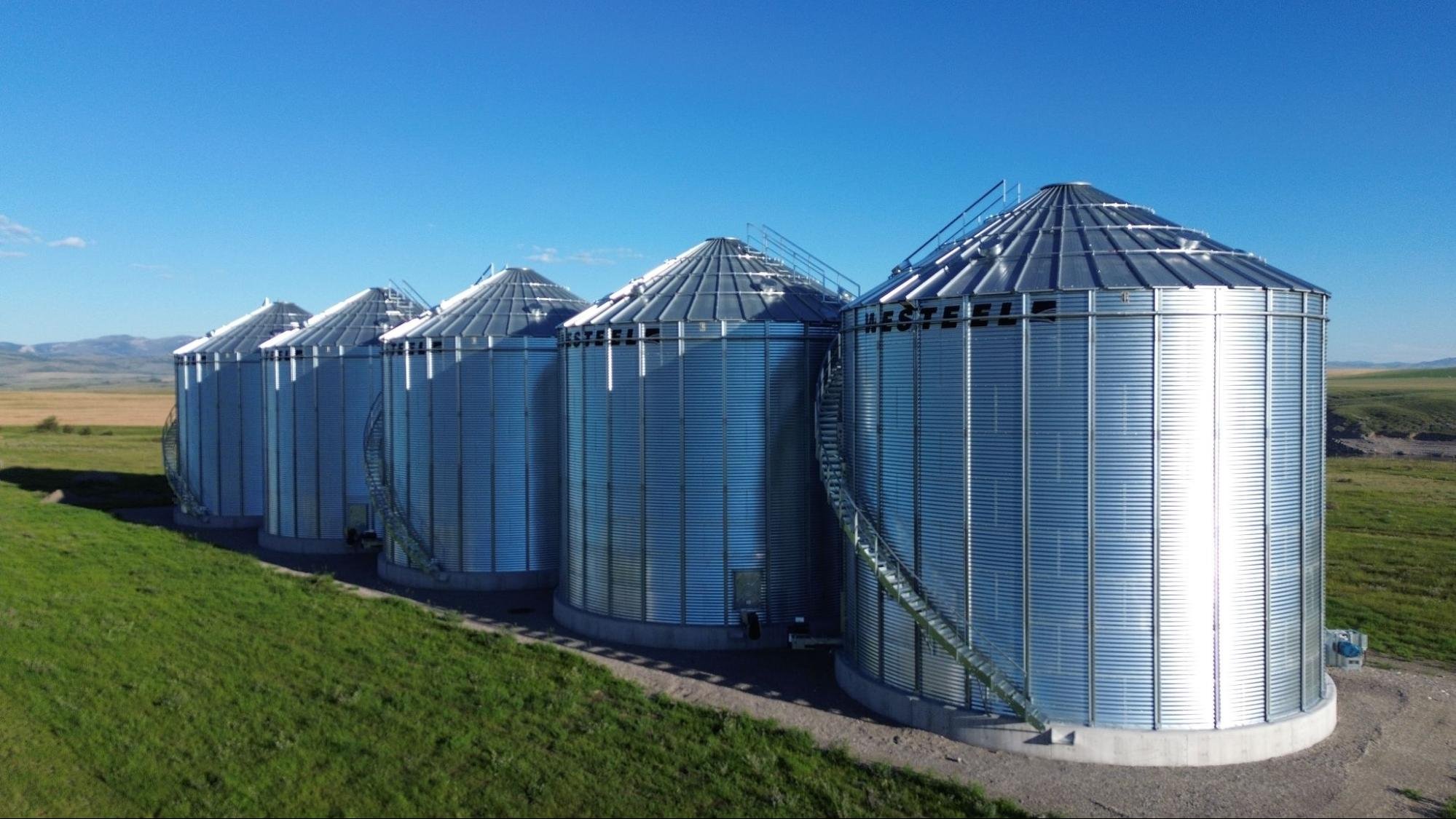
Large metal grain storage bins on a concrete base, illustrating how bin structure and temperature changes influence moisture migration in grain storage.
How Does Aeration Help Control Moisture Migration?
Aeration is one of the most effective tools for controlling moisture migration in grain storage. By moving air through the grain, aeration equalizes temperature throughout the bin. When temperature differences are minimized, the internal air movement that drives moisture migration slows or stops altogether.
The goal of aeration is not to dry grain significantly, but to cool it evenly and maintain stable conditions. Running fans at the right time, when outside air supports effective cooling, helps establish a uniform grain temperature. This reduces condensation risk and keeps moisture evenly distributed across the grain mass. In addition to fan operation, tools such as fan covers can also help manage airflow by preventing cold, dry, or freezing winds from entering bins during unfavorable weather conditions.
Improper aeration timing can be just as harmful as no aeration at all. Running fans continuously or under the wrong conditions may overdry grain or fail to address internal temperature gradients. Managing both when air is introduced and when it is blocked plays an important role in controlling moisture migration during long-term storage.
How Does Monitoring Improve Moisture Migration Management?
Monitoring systems play a critical role in detecting and managing moisture migration before damage occurs. Temperature and moisture sensors installed inside the bin allow producers to track changes throughout the grain mass in real time. Instead of relying on surface checks, operators can see what is happening deep within the bin.
GrainX monitoring systems provide continuous data that helps producers identify warming trends, developing hotspots, and moisture movement patterns. This information supports better aeration decisions and allows issues to be addressed early, before spoilage affects grain quality or grade.
Monitoring is especially important for farms storing grain over long winter periods or managing multiple bins. With large volumes of stored grain, early detection is key to preventing significant financial loss.
Why Is Moisture Migration A Bigger Risk In Western Canada?
Western Canadian storage conditions make moisture migration a persistent challenge. Large temperature swings between day and night, early winter cold snaps, and long storage periods all contribute to the risk. Producers often store grain for months while waiting for favorable market conditions, increasing the importance of stable storage environments.
Crop diversity also adds complexity. Wheat, canola, barley, oats, and pulses all respond differently to temperature and moisture changes. Managing moisture migration requires understanding how each crop behaves in storage and adjusting aeration and monitoring strategies accordingly.
How Can Producers Reduce The Risk Of Moisture Migration?
Reducing moisture migration starts with proper drying and clean bins. Grain should enter storage at safe moisture levels and uniform temperature. From there, consistent monitoring and well timed aeration help maintain stable conditions.
Producers can reduce risk by focusing on:
Even cooling of grain shortly after harvest
Monitoring internal bin temperatures regularly
Using aeration strategically to equalize temperatures
Ensuring bins are well sealed and structurally sound
Adjusting management practices as seasons change
These practices work together to limit moisture movement and protect grain quality throughout storage.
Why Understanding Moisture Migration Matters For Long Term Storage Success
Moisture migration in grain storage is a natural process, but it can be managed effectively with the right systems and knowledge. Understanding how and why moisture moves within a bin allows producers to take proactive steps rather than reacting to spoilage after it occurs.
When durable grain storage bins, proper aeration, and reliable monitoring systems work together, producers gain control over one of the most critical factors affecting grain quality. This approach protects grade, preserves value, and supports confident long term storage decisions.
To learn more about how real-time monitoring, automation, and data-driven control help manage moisture migration and protect grain quality, read our article: How Automated Grain Management Systems Are Changing On-Farm Storage.
Looking to upgrade or improve your grain storage setup? Contact us to get experienced support for protecting grain quality through every storage season.