
Commercial Grain Dryers: What Large Operations Need To Know
Article Overview:
This article explains what larger farms and commercial-scale grain operations need to consider when evaluating commercial grain dryers, including drying capacity, throughput, system layout, fuel efficiency, airflow, and integration with storage and handling equipment.
Why Commercial Grain Dryers Need To Match Harvest Pace
Commercial grain dryers must be sized around peak harvest conditions, not average production. During harvest, the system needs to keep grain moving while managing moisture levels, protecting quality, and preventing bottlenecks at receiving, drying, storage, or loadout.
A dryer that cannot keep up with harvest intake forces grain to sit longer than planned. This can create delays, increase handling pressure, and limit the producer’s ability to move when field conditions are right. In Western Canada, where harvest windows can be short and weather can shift quickly, drying capacity has a direct impact on operational flexibility.
At the same time, bigger is not always better. Oversizing a dryer can increase capital cost, fuel demand, and operating complexity without improving performance if the rest of the system cannot support it. Commercial-scale drying works best when dryer capacity, receiving speed, unload systems, conveyors, storage capacity, and airflow are designed to operate together.
What Throughput Means In A Commercial Drying System
Throughput is one of the most important factors in commercial dryer planning. It refers to how much grain can move through the drying system within a set period, usually measured in bushels per hour under specific moisture removal conditions.
Throughput depends on more than the dryer’s rated capacity. Actual drying performance can change based on crop type, incoming moisture, target moisture, outside temperature, humidity, fuel availability, airflow design, and how efficiently grain moves into and out of the dryer.
For example, removing a few points of moisture from relatively dry grain is very different from drying wetter grain under cold or damp conditions. A dryer may perform well under one set of conditions but become a bottleneck under another if it is not properly matched to the operation.
Large operations should look at real harvest demands, not just brochure ratings. The goal is to understand what the system can handle when conditions are difficult, volumes are high, and timing matters.
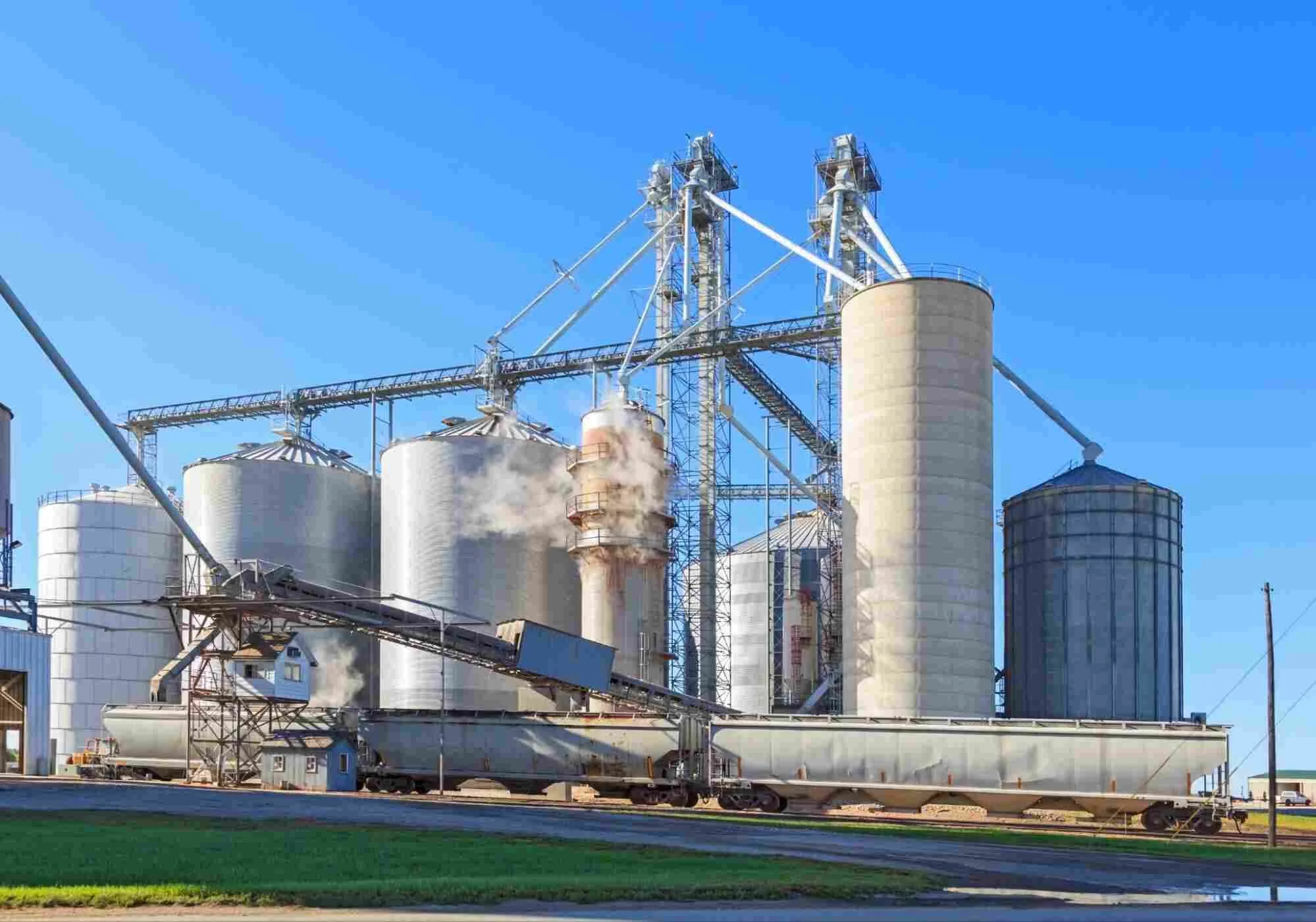
Commercial grain dryers and grain storage silos at a large agricultural processing facility, supporting efficient grain drying, handling, and transportation operations.
Key Factors When Choosing Commercial Grain Dryers
The right dryer depends on the full operating environment. Large producers should consider how the dryer will perform during peak harvest and how it will connect with storage, handling, and long-term grain management.
| Planning Factor | How It Affects The Operation |
|---|---|
| Harvest intake rate and expected daily drying volume | Determines how much grain the dryer must handle during peak harvest and whether the system can keep up without creating delays. |
| Crop types, average moisture levels, and wetter-year scenarios | Affects drying speed, heat requirements, airflow needs, and how much flexibility the system needs under challenging conditions. |
| Target moisture levels for safe storage or delivery | Guides drying strategy and helps prevent overdrying, underdrying, storage risk, or delivery issues. |
| Fuel availability, burner efficiency, and operating cost | Influences dryer performance, energy use, and long-term cost of operation. |
| Electrical capacity, controls, and service access | Determines whether the site can support the dryer, automation, monitoring, and safe, practical maintenance. |
| Receiving, transfer, and unloading equipment capacity | Impacts whether grain can move into and out of the dryer efficiently without bottlenecks. |
| Storage capacity before and after drying | Ensures wet grain can be held before drying and dried grain can move into proper storage without slowing harvest flow. |
| Airflow consistency and temperature control | Affects drying uniformity, grain quality, moisture removal, and the risk of overdrying or heat damage. |
| Integration with aeration, monitoring, and automation systems | Helps maintain grain condition after drying and supports better control through storage. |
| Future expansion needs and long-term site layout | Ensures the system can grow with the operation without requiring major redesign later. |
These details are important because the dryer is only one part of the system. A high-capacity dryer will not solve harvest delays if grain cannot be moved to it, unloaded from it, cooled properly, or transferred into the right storage.
Why System Integration Matters For Larger Operations
Commercial grain dryers must be planned as part of the larger grain system. Storage, drying, handling, aeration, monitoring, and site layout all influence how effectively the dryer performs.
If receiving capacity is too low, trucks wait. If handling equipment is undersized, the dryer may sit idle. If storage capacity after drying is limited, grain movement slows. If aeration and monitoring are not properly integrated, dried grain can still face quality risks during storage.
A properly designed system considers the full path of the grain. It looks at how grain enters the yard, how it moves into drying, how moisture is removed, how grain is cooled or conditioned, and how it is stored after drying. For larger farms, this level of planning is critical because small inefficiencies can multiply quickly across thousands of bushels.
System integration also supports long-term growth. A drying system should not only meet today’s needs. It should allow the operation to add storage, upgrade handling capacity, or improve monitoring without rebuilding the entire site.
Screen-Type And Mixed Flow Dryer Considerations
Commercial grain dryers come in different configurations, and each has its place depending on crop conditions, operating priorities, and system design.
Screen-type continuous flow dryers use perforated screens to move heated air through the grain column. They provide reliable drying performance, straightforward operation, and consistent moisture removal across a wide range of crop conditions.
Mixed flow screenless continuous flow dryers use internal ducting and external heat chambers to distribute air and heat evenly through the grain. This design helps maintain bushel weight and grain quality in wetter drying conditions while reducing fire risk. Unloading options such as a U-trough unloader or drag conveyor can also support efficient grain movement through the system.
For commercial-scale operations, the choice between dryer types should be based on more than initial cost. Grain quality, fuel efficiency, maintenance requirements, drying uniformity, crop mix, and integration with handling equipment should all be part of the decision.
For a deeper comparison of drying systems, read our guide to Grain Dryer Types Explained: Choosing The Drying Method That Fits Your Farm.
How Drying Affects Grain Quality And Storage Performance
Drying has a direct impact on grain value. Poor temperature control, uneven airflow, overdrying, or inconsistent moisture removal can reduce quality and create storage challenges later.
Commercial grain dryers should be designed to remove moisture efficiently while protecting the condition of the grain. This requires careful attention to heat application, airflow, retention time, discharge moisture, and downstream cooling or aeration.
Once grain leaves the dryer, storage management becomes just as important. Dried grain still needs proper airflow, monitoring, and condition control to maintain quality through storage. For larger operations, integrating drying with bin monitoring and automated fan control can help reduce risk and support more consistent long-term storage conditions.
For a closer look at what happens inside stored grain after drying, read our guide to The Science Of Moisture Migration: Protecting Grain Quality During Storage.
Planning Commercial Drying Capacity For Long-Term Growth
Large farms should approach commercial dryer planning with future capacity in mind. More acres, higher yields, changing crop rotations, and tighter harvest windows can all increase pressure on the drying system over time.
A dryer that fits the operation today may become undersized if storage expands or harvest speed increases. On the other hand, a dryer selected without considering layout, power, fuel, and handling capacity may create expensive limitations later.
Long-term planning should account for equipment placement, service access, truck movement, bin layout, unload capacity, and room for expansion. When these factors are addressed early, the drying system can support growth instead of limiting it.
Build A Drying System Around The Full Operation
Commercial grain dryers are not standalone equipment decisions. They affect harvest flow, storage performance, grain quality, energy use, and the overall efficiency of the operation.
For large farms and commercial-scale grain operations, the best drying system is one that matches real harvest demands and works with the full grain handling setup. Dryer capacity, storage layout, airflow design, handling equipment, and monitoring should all be planned together.
Wall Grain designs and installs commercial grain drying systems built around the realities of Western Canadian farming. If you are upgrading drying capacity, planning a new system, or improving how drying connects with storage and handling, contact Wall Grain to build a system that supports efficient harvest flow and long-term grain quality.